Product Installation
Process Overview
The Poly-Triplex installation process is like none other you'll find in the industry. Using the existing structure as a
mold, we can complete the installation without the need for excavation and disruption, in 4-6 hours for most cases.
The liners are fabricated and resins are blended in our 23,000 square foot manufacturing facility. Our liners consist
of three primary layers and they are custom fabricated to fit each structure. The three layers include: one non-permeable
inner membrane embedded on both sides with special polyester fibers, layered between two layers of structural fiberglass
saturated with epoxy resin. The liners are engineered in several standard liner weights to address varying structural
conditions within the structures. The custom manufactured liners are cured-in-place with a patented system of air pressure and steam.
Each custom manufactured Poly-Triplex liner is saturated at the jobsite with a two-part epoxy resin system that will
bond to wet or dry surfaces. The liner is then lowered into place with a crane or lifting device. The Poly-Triplex
liner is aligned so that it will contour to the shape of the host structure.
The liner is typically cured by applying approximately 500-1,000 pounds per square foot of pressure with the injection
of steam set at approximately 300 degrees. This causes the removable inflation bladder to fully expand, forcing the
liner to conform to the contours of the structure surface, stopping all active infiltration. In certain cases where
the typical method of installation is not appropriate, the Poly-Triplex system may be cured in an ambient temperature
environment or under hydrostatic pressure.
Manhole and catch basin installations typically take four to six hours to complete. Depending on site & structure size,
conditions and location, one three-man installation crew can line two structures per day with one installation truck.
After curing is complete, the bladder is removed, leaving the laminated composite liner system that is fully bonded
to the existing structure, permanently stopping further deterioration, infiltration and ex-filtration.
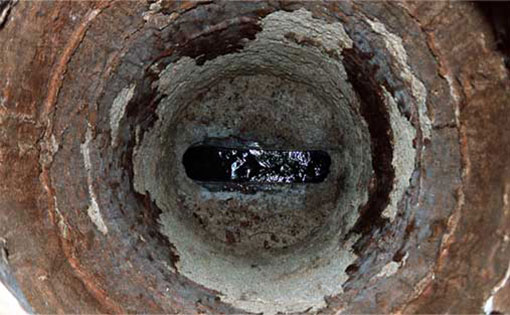
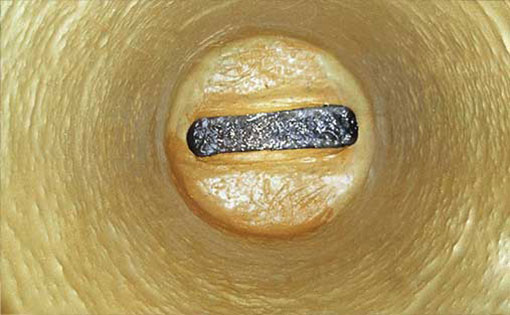
After the bladder is removed, pipes are reopened with a reciprocal saw or offset grinder. The sub-floor is removed
and the liner is trimmed at the invert channel. In this particular case, as photo above shows, the sewage has
continued to flow throughout the entire lining process with no disruption.
Pump Station and wet well installations are primarily the same as for manholes. Structure is empty and free
of all mechanicals and cleaned with high pressure hydro-blasting with a rotating pencil tipped nozzle. The liner's
bottom disk section is saturated and positioned on the floor and approximately 6 inches up the wall. The liner is then
saturated and lowered into the structure with the wall section overlapping the floor section a total of approximately
12 inches. Liner is typically cured in place under air pressure. Steam heat is injected to expedite the curing process.
Rectangular structures may be lined using Poly-Triplex overlapping panels and cured as a monolithic structure.
Pump Station rehabilitation usually can be completed within a 12-24 hour period, significantly minimizing bypass pumping operations.
Culvert and large diameter pipe lining is completed using a pull-through method of installation. Liner is saturated at the jobsite with an appropriate resin system. Liner and inflation bladder are typically encapsulated inside a durable reinforced vinyl skin, and then pulled through using a winch and cable system. Liner is then inflated and pressurized into place. Water and steam are injected facilitate the curing process. Once cured, the bladder is removed and structure is completely lined from end to end. In the case of longer runs, the liner may be installed in two or more overlapping sections. Typical culverts can be completed usually within a 12-24 hour period, with little or no disruption of highway traffic.
|
|